
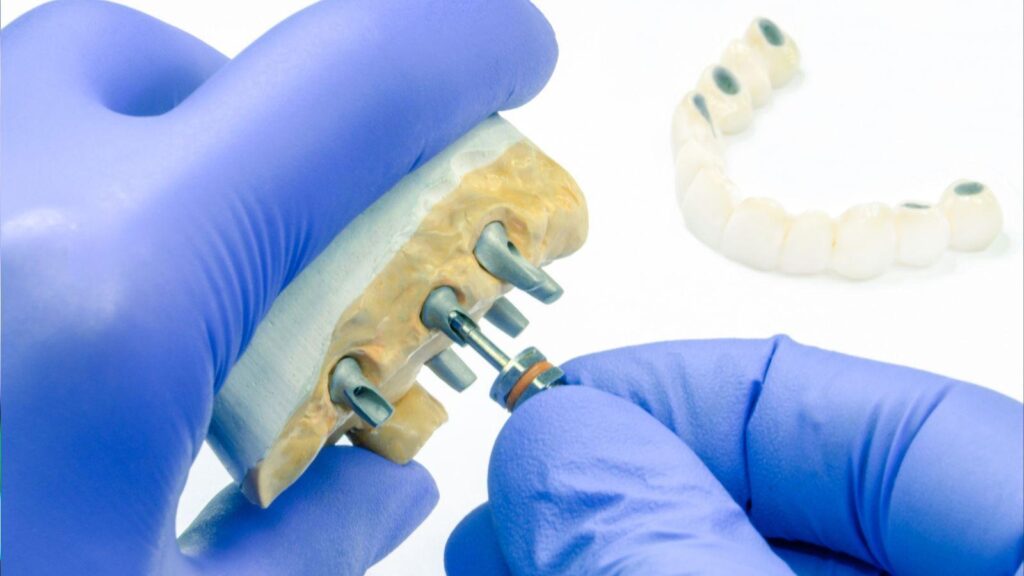
If you’re deciding between a four-implant overdenture and an All-on-4, focus on how you want the prosthesis to feel, function, and be maintained. A four-implant overdenture gives you a removable prosthesis with easier hygiene and usually lower initial cost, while All-on-4 provides a fixed bridge with greater day-to-day stability and a more natural feel — but often requires more complex care and higher upfront investment.
You’ll explore how implant placement and prosthesis materials affect comfort, esthetics, and long-term outcomes, plus which medical or bone factors push one option ahead of the other. Expect clear comparisons of retention, candidacy, maintenance needs, and cost so you can match the option to your lifestyle and clinical situation — or speak with a provider offering comprehensive dental implant services to find the right fit.
Implant Configurations and Materials
You’ll see differences in how implants are placed, how many support the prosthesis, and what materials make up the teeth and framework. These choices affect stability, chewing force, hygiene access, and long-term maintenance.
Structural Differences
A four‑implant overdenture uses four implants placed across the arch—often two anterior straight implants and two posterior implants that may be angled slightly. The prosthesis typically snaps onto a bar or individual attachments, and you remove it for cleaning. That removable design gives easier access under the denture for hygiene and relines.
All‑on‑4 places four implants (two anterior vertical, two posterior angled) that support a fixed bridge screwed to the implants. You cannot remove the bridge daily; the clinician removes it only for maintenance. The fixed design delivers higher bite force and a more natural ridge profile, but it requires meticulous oral hygiene and occasional professional screw checks.
Types of Implants Used
Both approaches use titanium or titanium‑alloy implants as the standard due to biocompatibility and predictable osseointegration. You may also encounter implants with a roughened, textured surface to speed bone integration. Diameter and length vary: wider/longer implants increase primary stability, especially in posterior regions.
For All‑on‑4, clinicians often select tapered implants with angulated posterior fixtures to maximize bone engagement and avoid sinus or nerve anatomy. For overdentures, clinicians may choose shorter or narrower implants when bone is limited because the prosthesis shares load and can be more forgiving. In some cases, zirconia implants appear as an alternative for metal‑sensitive patients, but they remain less common.
Prosthesis Materials
Overdentures commonly use an acrylic base with acrylic or composite teeth. Acrylic keeps cost and weight lower and allows easy lab adjustments and relines. You can also have a metal‑reinforced bar under the acrylic for added strength; that increases durability but adds bulk.
All‑on‑4 prostheses usually use a titanium or cobalt‑chromium framework veneered with acrylic or layered/monolithic zirconia teeth. Titanium or Co‑Cr frameworks resist flex and distribute occlusal forces to the implants. Full‑contour zirconia offers superior strength and wear resistance but transmits more force to implants and can be more challenging to adjust. Choose materials based on your functional needs, aesthetic goals, and willingness for upkeep.
Retention and Stability
Retention and stability determine how securely your denture stays in place and how natural your bite feels. These factors affect chewing, speech, comfort, and how often you’ll need adjustments or maintenance.
Attachment Mechanisms
Four-implant overdentures typically use removable attachments such as ball (stud), locator, or bar systems. Ball and locator attachments clip the denture to individual implants for simple removal and low-profile retention. Bars link the implants with a metal framework; your denture snaps onto the bar and can distribute forces across implants more evenly.
All-on-4 restorations are usually fixed to the implants with screws or cement and are not intended for daily removal. That fixed connection provides constant, rigid retention and eliminates attachment wear you’d manage with removable overdentures. If you need maintenance, the clinician can unscrew the prosthesis, but you won’t remove it for cleaning each night.
Impact on Oral Function
With a four-implant overdenture, you gain far better retention than a conventional denture, reducing slippage during eating and speaking. Because the prosthesis remains removable, you can clean both the denture and implant sites thoroughly at home. Expect slightly more movement under heavy loads compared with fixed options, which may limit certain tough foods.
All-on-4 provides near-natural stability and allows stronger bite force and better chewing efficiency. The rigid fixation reduces micro-movement that can irritate soft tissues and improves confidence with sticky or fibrous foods. Repairs or relines require professional visits, and you rely on routine in-office maintenance rather than daily removal for hygiene.
Candidacy and Clinical Considerations
You need to weigh factors that affect comfort, function, and long-term success: your general health, jawbone quantity and quality, budget, and how much maintenance you want. These specifics determine whether a four‑implant overdenture or an All‑on‑4 fixed bridge fits your needs.
Patient Suitability Factors
You should assess medical history first. Conditions such as uncontrolled diabetes, heavy smoking, or osteoporosis raise risks for implant failure and may require medical management before proceeding.
Your manual dexterity and willingness to perform daily hygiene matter. Overdentures allow removable cleaning, which can be easier if you have limited dexterity; fixed All‑on‑4 restorations require meticulous hygiene under and around the prosthesis.
Consider functional goals and lifestyle. If you want higher bite force and minimal movement when chewing, All‑on‑4 typically gives better fixed‑prosthesis stability. If cost control, easier prosthesis removal, or future adjustments are priorities, a four‑implant overdenture may serve you better.
Discuss esthetic expectations with your clinician. Overdentures often have a thicker acrylic base that affects lip support differently than the slimmer All‑on‑4 prosthesis.
Required Bone Volume
You must have adequate bone where implants will be placed; quantity and quality vary between arches. The All‑on‑4 protocol often angles posterior implants to engage denser anterior bone, reducing the need for grafting in many cases. This can be advantageous if you have moderate posterior resorption.
A four‑implant overdenture can work with less bone because designs allow use of two to four implants in the anterior jaw and sometimes shorter or narrower implants.
Your clinician will evaluate bone with CBCT imaging to measure height, width, and density. Expect specific thresholds: generally at least 8–10 mm vertical bone for standard implants and 5–6 mm buccolingual width, though alternatives (short implants, angled placement, or grafting) can modify these limits.
If bone volume is borderline, discuss bone grafting, sinus lifts, or choosing an option that minimizes grafting—your treatment plan should list exact implant positions and any augmentation required.
Cost, Longevity, and Maintenance
You will balance upfront expense, predictable long-term costs, and daily/annual care when choosing between a four-implant overdenture and an All‑on‑4 fixed bridge. Expect different surgical complexity, prosthetic lifespans, and routine tasks that affect budget and lifestyle.
Comparative Costs
Four-implant overdentures usually cost less initially than an All‑on‑4 fixed bridge because the overdenture prosthesis itself is less complex and can be fabricated at lower lab expense. You should budget for implant placement, abutments/attachments, the removable denture, and periodic relines or replacement of the denture base—typically lower upfront but recurring costs over years.
All‑on‑4 carries a higher one-time surgical and prosthetic price due to a fixed multi‑unit bridge and more complex framework. You will still face future costs for occasional screw or veneer repairs and professional maintenance. Regional pricing, bone grafting need, and number/type of implant components can shift either option’s final cost.
Long-Term Durability
Implants themselves commonly last decades with proper care; however, the prosthesis differs. Overdentures often need relining, rebasing, or full replacement every 5–10 years depending on wear, fit, and ridge changes. Attachment components (locators, bars, clips) wear and may require replacement every 1–5 years.
All‑on‑4 fixed bridges provide a more durable functional surface and typically last 10–20 years before major prosthetic renewal is needed. Individual veneer teeth or acrylic teeth on a metal framework may chip and require repair sooner. Bone preservation around implants tends to be better with fixed solutions, which can affect long-term implant stability.
Maintenance Requirements
With a four‑implant overdenture you must remove the denture daily for cleaning. Clean the attachments and implant posts with a soft brush and use denture cleaner for the prosthesis. Plan on professional checks every 3–6 months for attachment wear, relines, and hygiene.
All‑on‑4 fixed bridges require daily brushing, interdental cleaning under and around the prosthesis, and routine professional hygiene every 3–6 months. You may need specialized floss, interdental brushes, or water-irrigation to clean under the bridge. Repairs are less frequent but can be more complex and costly when they do occur.